


GMP standards are the standards that many pharmaceutical companies want to achieve. However, achieving this standard is not easy, requiring a lot of knowledge and high skills right from the factory construction. To build a pharmaceutical factory today, we cannot help but mention Panel – a popular clean room construction material. Let’s learn how to choose the right panel in a pharmaceutical factory and some notes when constructing pharmaceutical clean room panels.
1. CLASSIFICATION OF PANEL PANELS USED IN PHARMACEUTICAL FACTORIES
Sandwich Panel Classification:
Panels are often classified according to materials such as: Magnesium Oxide Panel, Mineral Wool Panel, Polystyrene Foam Panel, Honeycomb Paper Panel and Honeycomb Aluminum. However, materials such as honeycomb paper, honeycomb aluminum and polystyrene foam panels are not accepted because they cannot comply with fire prevention and fighting regulations. Using panels with good heat transfer properties will cause the temperature on the other side of the panel to quickly exceed 300 ℃, which does not meet fire protection requirements. However, in some areas, polystyrene panels with fire retardants can be used.
Classification of panel production methods:
Panels will be produced in two ways: manual production and industrial production. Currently, most manual panels have the same durability as industrial machine-made panels. However, mineral wool panels must be handmade because they will not maintain their durability when made by machine. Manually produced panels will often cost more than machine-made panels, but the quality of manual panels is always guaranteed.
2. SELECTING PANELS FOR PHARMACEUTICAL FACTORIES
Nowadays, pharmaceutical companies often choose magnesium oxide panels to build factories because this material has high durability and fire resistance. However, in cold climate areas, poor factory heating systems will cause poor heat retention, especially condensation on the ceiling. Some poor quality panels may peel off the ceiling or wall.
Companies that want to save costs can also apply the following solutions: corridors, main pedestrian walkways, emergency exits, and explosive areas should use magnesium oxide panels. Other areas can use cheaper panels but still ensure the necessary safety. This will help pharmaceutical businesses save costs when building clean rooms with panels. 3.
METHODS AND REQUIREMENTS FOR CONSTRUCTION OF PHARMACEUTICAL CLEAN ROOM PANELS
Some notes when constructing pharmaceutical clean room panels.
1. Before installation, clean the air duct, the location in the filter area and remove all items unrelated to the clean room construction.
2. The contractor will draw specific sub-design drawings based on the main design drawings. The contents include panel ceiling layout drawings, panel wall layout drawings, related diagrams and technical parameters confirmed by both parties according to actual requirements.
3. When the panel is transported from the factory, protective measures such as proper packaging and careful handling must be taken to avoid impacts on the surface layer during transportation. The storage area for the panel and other accessories must be dry, clean, flat and firmly placed, and must be covered and protected around the management area if possible. The stacking of panels must be neat and even, with a stacking height of no more than 2.0 meters.
4. After the panel is delivered to the construction site, a product qualification certificate and related documents must be issued, and inspection procedures must be completed. The surface of the panel must not have scratches, and the geometric dimensions must meet the requirements of the design drawings. If there are scratches, the contractor will carry out technical treatment after removing the protective film.
5. Do not tear off the plastic protective film on the surface of the wall panels during installation, and do not collide or step on their surfaces. Accessories and various materials must be strictly tested for specifications, performance and integrity. At the same time, it is strictly forbidden to use unqualified or damaged accessories.
6. All installation gaps in the clean room area must be sealed with silicone glue. Before gluing, the installation gaps must be strictly cleaned to remove impurities and oil stains to ensure that the glue is solid, avoiding falling off and accumulating dust. The surface of the silicone glue must be smooth and wrinkle-free.
7. The project must be cleaned daily after completion to maintain the durability of the project.
Installation and construction of pharmaceutical clean room panels
Panel installation should be carried out after the basic clean room construction is completed, the main components such as ventilation system, electrical system are almost complete. During the installation process, the cutting machine and other machinery, installation accessories, construction site need to be cleaned and wiped clean at any time. According to the installation order, the wall must be installed before the ceiling is installed.
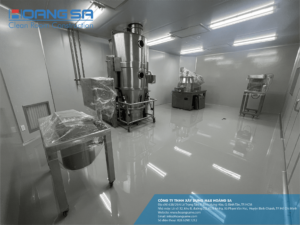
Pharmaceutical clean room wall construction
– Set the straight line according to the panel partition layout diagram. The corners of the wall must be connected vertically and the diagonal error of the room must be less than 1%.
– Clean the site according to the standard to ensure no dust.
– The verticality of the wall panel installation must be calibrated by the vertical magnetic field line and the deviation must not be greater than 1%. In order to avoid the accumulation of errors causing the wall panel to tilt and twist, the gap between these panels must be strictly controlled within 2.5mm between the upper and lower surfaces and must be kept equal.
– When arc welding aluminum inside the corners formed by the connection between the wall and the ceiling, it should be cleaned in advance. The corner formed by the wall and the ceiling must be sealed with construction glue.
– The construction departments must cooperate to determine the opening size and location of the switch socket.
Pharmaceutical clean room ceiling panel construction
– During the installation process, first determine the connection and fixing position of the three-dimensional structure such as hanging beams, anchors, roof beams that need to be lifted and the reinforced lifting points according to the secondary design layout drawing, as follows:
• The hanging ribs are 1.2m arranged vertically and horizontally.
• The roof beams are fixed with φ10mm expansion screws inside, the other end of the hanging ribs is connected with galvanized sleeve bolts and specialized galvanized hidden hanging beams to adjust the flatness of the roof.
– The ceiling should be installed in the direction of the room, the gap should only be maintained within 2-3mm, and the upper surface is connected to the hidden beams with 0.5m rivets to firmly connect each other.
– In addition to hanging the beams in width, it is necessary to increase the length and use specialized C-shaped steel to reinforce the hanging beams and the corrugated iron roof is connected with dovetail screws, and then the hanging ribs will be used to lift.
– After completing the ceiling construction, the next work must take protective measures for the ceiling construction and strictly prohibit large-scale processing and manufacturing on the ceiling.
Hoang Sa Company with many years of experience, is a unit specializing in construction and installation of clean rooms in the fields of food production, cosmetics, pharmaceuticals, medical…
Let Hoang Sa become your business companion, contact Hoang Sa M&E now for detailed advice:
M&E HOANG SA CONSTRUCTION COMPANY LIMITED
Address: 638/29/6 Le Trong Tan, Binh Hung Hoa Ward, Binh Tan District, Ho Chi Minh City
Factory: Lot 32, Area B, Road D2, An Ha Industrial Park, Pham Van Hai Commune, Binh Chanh District, Ho Chi Minh City
Email: info@hoangsame.com
Phone number: 0987008047
Zalo: 0987008047
Website: www.hoangsame.com